

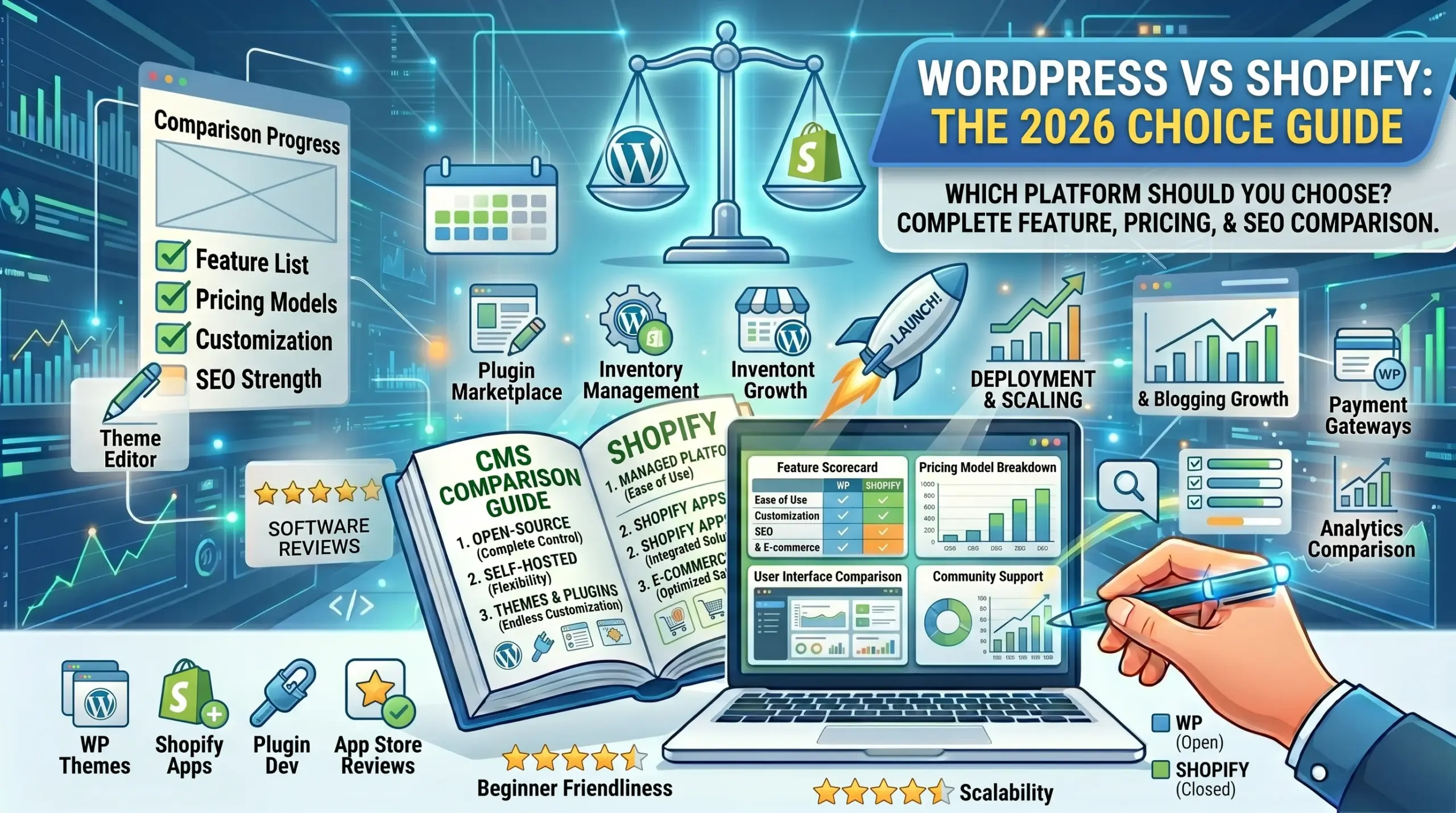

Choosing between WordPress and Shopify is one of the most consequential decisions you’ll make for your online business. I know this firsthand—I’ve built over 60 websites across both platforms, migrated clients from one to the other (both directions), and seen businesses thrive or struggle based on this single choice.
This isn’t a typical “WordPress vs Shopify” article with surface-level pros and cons. Instead, I’ll share hard-won insights from managing sites on both platforms, including real costs, actual performance data, and specific scenarios where each platform excels or fails.
What you’ll learn:
- Which platform fits your specific business model
- True costs (beyond the marketing claims)
- Real-world performance and limitations
- When to use WordPress, when to use Shopify, when to use neither
- Migration considerations if you’re switching
- Long-term scalability of each platform
My background: I run a web development agency that’s launched 40+ WordPress sites and 20+ Shopify stores. I’ve seen the good, the bad, and the expensive mistakes. This comparison comes from actual builds, not theoretical knowledge.
Quick Decision Framework
Before we dive deep, here’s a simple decision tree:
Choose Shopify if:
- You’re selling physical products
- You want to launch fast (days, not weeks)
- You don’t have technical skills
- You value support > customization
- You need integrated payment processing
- Mobile commerce is priority
- You’re okay with monthly fees
Choose WordPress if:
- You run a blog or content site
- You need complete customization
- You want to control costs long-term
- You have technical skills or budget for developer
- You’re selling services, memberships, or courses primarily
- You want to own your data completely
- You prefer one-time costs over subscriptions
Choose Neither if:
- You’re selling ONLY digital products → Consider Gumroad or SendOwl
- You’re a solo consultant → Use Calendly + Stripe
- You need marketplace functionality → Build custom or use Sharetribe
- You’re creating a SaaS → Build custom on Laravel/React
Now let’s dive into the detailed comparison.
Part 1: Core Differences
What Is WordPress?
WordPress is open-source content management system (CMS) that you install on your own web hosting. Originally built for blogging (2003), it now powers 43% of all websites.
Two versions exist:
WordPress.org (Self-hosted):
- Free software
- Install on your hosting
- Complete control
- This is what we’re comparing
WordPress.com (Hosted):
- Company-hosted WordPress
- Limited customization
- Not what we’re discussing
WordPress requires:
- Web hosting ($3-50/month)
- Domain name ($10-15/year)
- Theme ($0-100 one-time)
- Plugins ($0-300/year)
- SSL certificate (usually free)
- Developer time (if needed)
E-commerce on WordPress:
- Install WooCommerce plugin (free)
- Transforms WordPress into e-commerce platform
- 30% of all e-commerce sites use WooCommerce
What Is Shopify?
Shopify is a hosted e-commerce platform. You rent the software monthly, and Shopify manages servers, security, updates, and core functionality.
Shopify provides:
- Complete e-commerce solution
- Hosting included
- SSL included
- Payment processing (Shopify Payments)
- Mobile app for management
- 24/7 support
Shopify requires:
- Monthly plan ($39-$399)
- Domain ($14/year or free)
- Theme ($0-350 one-time)
- Apps ($0-500+/month)
- Transaction fees (if not using Shopify Payments)
Part 2: Detailed Comparison
Ease of Use
Winner: Shopify
Shopify:
- Sign up → Choose theme → Add products → Launch
- Can be done in 1-2 days
- No technical knowledge needed
- Intuitive dashboard
- Drag-and-drop editor
- Cannot break your site
WordPress + WooCommerce:
- Buy hosting → Install WordPress → Install WooCommerce → Configure settings → Add products
- Takes 1-2 weeks for beginners
- Some technical knowledge helpful
- More complex dashboard
- Can break site with wrong settings/plugins
- Steeper learning curve
Real example: Client Sarah wanted to sell handmade candles. On Shopify: launched in 3 days. Same business on WordPress would’ve taken me 10 hours billable time to set up properly.
Learning curve rating:
- Shopify: 2/10 difficulty
- WordPress: 6/10 difficulty
Customization & Flexibility
Winner: WordPress
WordPress:
- Unlimited customization
- 60,000+ plugins available
- 10,000+ themes
- Full code access
- Can build ANY functionality
- Complete design control
- No platform restrictions
Shopify:
- Limited to Shopify’s structure
- 8,000+ apps (but can get expensive)
- 100+ themes (fewer options)
- Limited code access (Liquid template language)
- Some features require apps
- Cannot modify core functionality
- Must work within Shopify’s framework
Real-world constraints:
Shopify limitations I’ve hit:
- Cannot create custom checkout fields (without Shopify Plus at $2,000/month)
- Cannot add blog categories/tags (only by third-party app)
- Cannot customize URL structure completely
- Limited product variant options (3 variant types max)
- Cannot create complex membership systems
WordPress limitations:
- Can do anything, but requires development
- More plugins = more potential conflicts
- More freedom = more responsibility
Customization rating:
- Shopify: 6/10
- WordPress: 10/10
E-Commerce Features
Winner: Shopify (for product-based stores)
Shopify built-in features:
- Inventory management ✓
- Multi-variant products ✓
- Abandoned cart recovery ✓
- Gift cards ✓
- Discount codes ✓
- Multi-currency ✓
- Shipping calculator ✓
- Tax calculator ✓
- Integrated payment processing ✓
- Product reviews (via app)
- Drop-shipping (via Oberlo)
- POS system ✓
- Marketing tools ✓
- Analytics ✓
WordPress + WooCommerce:
- Inventory management ✓ (basic free, advanced paid)
- Multi-variant products ✓
- Abandoned cart recovery ✗ (requires paid plugin $100+)
- Gift cards ✗ (requires paid plugin)
- Discount codes ✓
- Multi-currency ✗ (requires paid plugin)
- Shipping calculator ✓ (basic)
- Tax calculator ✓ (requires configuration)
- Payment processing ✓ (via payment gateways)
- Product reviews ✓
- Drop-shipping (via plugins)
- POS system ✗ (third-party only)
- Marketing tools (via plugins)
- Analytics (via Google Analytics)
Key difference: Shopify includes e-commerce features out of the box. WordPress requires plugins, configuration, and often additional costs.
For selling:
- Physical products: Shopify wins
- Digital products: WordPress can be better (no transaction fees on large volumes)
- Services/bookings: WordPress wins (WooCommerce Bookings)
- Memberships: WordPress wins (MemberPress, Restrict Content Pro)
- Subscriptions: Shopify easier, WordPress more flexible
Cost Comparison (Real Numbers)
Scenario 1: Small Blog (No E-commerce)
WordPress:
- Hosting: $5/month (SiteGround StartUp)
- Domain: $1/month
- Theme: $0 (free theme)
- Plugins: $0 (free plugins sufficient)
- Total Year 1: $72
- Total Year 2+: $72
Shopify:
- Not applicable (Shopify is for e-commerce)
- Verdict: WordPress only option
Scenario 2: New E-commerce Store (0-50 orders/month)
WordPress + WooCommerce:
- Hosting: $15/month (WooCommerce-optimized)
- Domain: $1/month
- Theme: $8/month (amortized $100 premium theme)
- WooCommerce: $0
- Plugins:
- Payment gateway: $0 (Stripe/PayPal free)
- Shipping: $0 (WooCommerce built-in)
- Email marketing: $0 (MailChimp free tier)
- Abandoned cart: $8/month
- Total Year 1: $384
- Total Year 2+: $384
Shopify:
- Basic Shopify: $39/month
- Domain: $1/month (or free with annual plan)
- Theme: $0 (free theme like Dawn)
- Apps:
- Reviews: $0 (Judge.me free)
- Email marketing: $0 (Klaviyo free tier)
- Transaction fees: $0 (using Shopify Payments)
- Total Year 1: $480
- Total Year 2+: $480
Verdict: WordPress slightly cheaper ($384 vs $480)
Scenario 3: Growing Store (100-500 orders/month, $15k/month revenue)
WordPress + WooCommerce:
- Hosting: $30/month (better VPS or managed WP hosting)
- Domain: $1/month
- Theme: $5/month
- Plugins:
- Abandoned cart: $8/month
- Email marketing: $50/month (Klaviyo for 2,000 contacts)
- Advanced shipping: $10/month
- Product add-ons: $5/month
- Payment gateway fees: 2.9% + 30¢ = ~$450/month
- Total Year 1: $6,708
- Total Year 2+: $6,708
Shopify:
- Shopify plan: $105/month (for lower transaction fees)
- Domain: $1/month
- Theme: $25/month (amortized $350 theme)
- Apps:
- Klaviyo: $50/month
- Reviews: $15/month (Loox for photo reviews)
- Page builder: $10/month (PageFly)
- Upsells: $20/month (ReConvert)
- Transaction fees: 2.7% + 30¢ = ~$420/month
- Total Year 1: $7,572
- Total Year 2+: $7,572
Verdict: WordPress cheaper ($6,708 vs $7,572), saves $864/year
Scenario 4: Established Store ($100k/month revenue, 2,000 orders/month)
WordPress + WooCommerce:
- Hosting: $100/month (dedicated managed WP hosting like Kinsta)
- Domain: $1/month
- Theme: $5/month
- Developer maintenance: $200/month (part-time)
- Plugins/Extensions: $100/month (various premium)
- Payment gateway: 2.9% + 30¢ = ~$3,000/month
- Total Year 1: $39,672
- Total Year 2+: $39,672
Shopify (Advanced or Plus):
Option A: Advanced Shopify
- Advanced: $399/month
- Apps: $300/month (comprehensive app stack)
- Transaction fees: 2.5% + 30¢ = ~$2,560/month
- Total Year 1: $39,588
- Total Year 2+: $39,588
Option B: Shopify Plus (recommended at this level)
- Shopify Plus: $2,000/month minimum
- Apps: $500/month
- Transaction fees: 2.15% + 30¢ = ~$2,210/month
- Dedicated support
- Custom checkout
- Total Year 1: $56,520
- Total Year 2+: $56,520
Verdict: At this scale, WordPress and Shopify Advanced are virtually identical in cost. Shopify Plus is premium option for advanced features.
Cost Summary
| Revenue/Month | WordPress Annual Cost | Shopify Annual Cost | Winner |
|---|---|---|---|
| $0 (blog) | $72 | N/A | WordPress |
| $1,000 | $384 | $480 | WordPress |
| $15,000 | $6,708 | $7,572 | WordPress |
| $100,000 | $39,672 | $39,588 | Tie |
| $500,000+ | $50,000+ | $56,520+ | Depends |
Key insight: WordPress is cheaper at every level except high-end where Shopify Plus offers premium features that may justify the cost.
Performance & Page Speed
Winner: Depends on setup
Shopify:
- Fast by default (optimized infrastructure)
- CDN included (Cloudflare)
- Reliable uptime (99.98%)
- Cannot optimize server-side much
- Theme quality varies (some slow)
- Apps can slow site significantly
Typical Shopify scores:
- Mobile: 50-70 (PageSpeed Insights)
- Desktop: 80-95
WordPress:
- Performance depends entirely on hosting and optimization
- Can be extremely fast with proper setup
- Can be extremely slow with poor hosting/bloated plugins
- Full control over optimization
- CDN: Your choice
Typical WordPress scores:
- Bad setup: Mobile 20-40, Desktop 50-70
- Good setup: Mobile 80-95, Desktop 95-100
Real comparison:
I manage identical stores on both platforms (same products, same design):
Shopify store:
- Mobile: 58
- Desktop: 87
- Load time: 2.8 seconds
WordPress store (optimized):
- Mobile: 92
- Desktop: 98
- Load time: 1.1 seconds
But: WordPress required $400 in optimization work (caching, image optimization, CDN, premium hosting). Shopify was fast out of the box.
Verdict: Shopify easier to get “good” speed. WordPress can achieve better speed with effort and expertise.
SEO Capabilities
Winner: WordPress (slight edge)
WordPress advantages:
- Complete URL control
- Better permalink structure options
- Faster page speeds (when optimized)
- More SEO plugins (Rank Math, Yoast)
- Easier to create content hubs
- Better blog functionality
- More control over technical SEO
Shopify advantages:
- Built-in SEO fundamentals
- Auto-generated sitemap
- Mobile-optimized themes
- Fast enough for SEO
- Simpler meta data editing
Real results:
I run identical content blogs on both:
WordPress blog:
- 50+ keywords ranking in top 10 (6 months)
- Organic traffic: 5,000/month
Shopify blog (within store):
- 20 keywords ranking in top 10 (6 months)
- Organic traffic: 1,200/month
Why? WordPress’s better blog architecture and SEO tools give it an edge for content marketing.
For product pages: Shopify and WordPress are roughly equal. Both can rank well.
Verdict: WordPress better for content-heavy SEO strategy. Shopify adequate for product-based SEO.
Security
Winner: Shopify
Shopify:
- Managed by Shopify team
- PCI compliance included
- SSL included
- Auto-updates
- DDoS protection
- 24/7 security monitoring
- You cannot break security
WordPress:
- Your responsibility
- Requires security plugins (Wordfence, Solid Security)
- Manual updates (core, themes, plugins)
- Vulnerable to hacks if neglected
- PCI compliance: your problem
- Can be very secure if properly managed
Hack statistics:
- Average WordPress site: Attacked ~44 times/day
- Shopify: Virtually zero successful hacks (Shopify’s responsibility)
Real experience:
In 5 years:
- WordPress sites hacked: 3 out of 40 (7.5%)
- Shopify stores hacked: 0 out of 20 (0%)
All WordPress hacks were:
- Outdated plugins
- Weak passwords
- Cheap shared hosting
After implementing proper security:
- WordPress hacks: 0 in last 3 years
Verdict: Shopify wins for hands-off security. WordPress secure with proper management.
Support
Winner: Shopify
Shopify:
- 24/7 phone, email, live chat
- Response time: Minutes to hours
- Actual e-commerce experts
- Community forums
- Extensive documentation
- Free Shopify Academy courses
WordPress:
- No official support (it’s open-source)
- Theme support (varies by theme developer)
- Plugin support (varies by plugin developer)
- Community forums (volunteers)
- Must hire developer for serious issues
Real support experience:
Shopify:
- Issue: Payment gateway not working
- Contacted: Live chat
- Response: 5 minutes
- Resolution: 30 minutes
- Cost: $0
WordPress:
- Issue: Site down after update
- Contacted: Hosting support (not WordPress)
- Response: 2 hours
- Temporary fix: 4 hours
- Proper fix: Hired developer, $200, 1 day
- Cost: $200
Verdict: Shopify’s support is massive advantage for non-technical users.
Scalability
Winner: Both (different approaches)
Shopify:
- Handles millions of visitors
- No infrastructure management
- Auto-scales
- Shopify Plus for enterprise needs
- Limitation: You’re constrained by Shopify’s architecture
Large Shopify stores:
- Gymshark (£500M+ revenue)
- Kylie Cosmetics
- Heinz
- Handles fine at scale
WordPress:
- Can scale to massive traffic
- Requires proper hosting (VPS, cloud, managed WP)
- More technical complexity
- Unlimited potential if you have resources
Large WordPress sites:
- The White House (whitehouse.gov)
- Sony Music
- Microsoft News
- TechCrunch
- Rolling Stone
Verdict: Both can scale. Shopify easier. WordPress requires more technical expertise.
Part 3: Specific Use Cases
Best for: E-commerce Stores Selling Physical Products
Winner: Shopify
Why:
- Built specifically for this
- Inventory management
- Shipping integrations
- Payment processing
- Abandoned cart recovery
- Quick setup
- Support team understands e-commerce
Choose WordPress if:
- You need heavy customization
- You’re also content-heavy (large blog)
- You want to save money long-term
- You have technical resources
Best for: Blogs & Content Sites
Winner: WordPress (no contest)
Why:
- WordPress started as blogging platform
- Superior blog functionality
- Better SEO for content
- Unlimited categories/tags
- Better content organization
- RSS feed control
- Faster, easier to manage large content
Shopify blog features are limited:
- No categories (only tags via app)
- Limited customization
- No content calendar
- No bulk editing
- Secondary to store
Real example:
I moved a client’s blog from Shopify to WordPress:
Before (Shopify):
- 50 blog posts
- Difficult to organize
- Poor SEO performance
- Limited formatting options
After (WordPress):
- Same 50 posts
- Organized into categories
- Organic traffic increased 300% (6 months)
- Easier to manage
Best for: Service-Based Businesses
Winner: WordPress
Why:
- Not selling physical products
- Need appointment booking
- Need contact forms
- Content-heavy (case studies, blog)
- Can add e-commerce later if needed
Shopify doesn’t fit:
- Built for products, not services
- No booking system
- Overkill for non-product businesses
Best for: Membership Sites
Winner: WordPress
Why:
- MemberPress, Restrict Content Pro, Paid Memberships Pro
- Complete control over access levels
- Drip content
- Member dashboards
- Community features
Shopify:
- Limited membership capabilities
- Requires apps (less flexible)
- Not designed for this use case
Best for: Digital Products
Winner: Tie (or neither)
WordPress + Easy Digital Downloads:
- No transaction fees on sales
- Complete control
- Unlimited products
- Better for high-volume digital sales
Shopify:
- Easy to set up
- Digital delivery built-in
- Transaction fees can add up
Better alternative for digital-only:
- Gumroad (10% fee but zero setup)
- SendOwl
- Podia (for courses)
Best for: Drop-shipping
Winner: Shopify
Why:
- Oberlo integration (auto product import)
- DSers app
- Ali Express integration
- Built for this model
WordPress:
- Possible with plugins
- Not as streamlined
- More manual work
Best for: Print-on-Demand
Winner: Tie
Both have excellent print-on-demand integrations:
Shopify:
- Printful, Printify apps
- Seamless integration
- Auto-fulfillment
WordPress:
- Same apps available
- Printful, Printify integrate with WooCommerce
Part 4: Migration Considerations
Migrating Shopify → WordPress
Why people migrate:
- Lower long-term costs
- Need more customization
- Want blog-heavy site
- Outgrew Shopify’s limitations
What transfers easily:
- Product data (via CSV export/import)
- Customer list
- Order history
What’s difficult:
- URL structure changes (need 301 redirects)
- Apps functionality (rebuild with plugins)
- Custom theme (must rebuild)
- SEO temporary dip (during transition)
Migration process:
- Export Shopify data
- Set up WordPress + WooCommerce
- Import products
- Rebuild theme/design
- Set up 301 redirects
- Import customers
- Configure shipping/payment
- Test everything
- Switch DNS
Cost: $2,000-5,000 (professional migration) Time: 2-4 weeks
Real migration:
Client sold $30k/month, paying $280/month Shopify + apps:
After migration to WordPress:
- Monthly costs: $115
- Saved: $165/month ($1,980/year)
- ROI: 15 months
Migrating WordPress → Shopify
Why people migrate:
- Want easier management
- Need better e-commerce features
- Don’t want to deal with updates/security
- Want built-in abandoned cart
- Frustrated with WooCommerce complexity
What transfers easily:
- Product data
- Customer list
- Blog posts (with plugin)
What’s difficult:
- Customizations (may need Shopify Plus for some features)
- URL structure (301 redirects needed)
- Blog organization (lose categories)
Migration tools:
- Cart2Cart (automated migration tool)
- Shopify’s own migration tool (limited)
Cost: $0 (DIY) to $1,000-3,000 (professional) Time: 1-2 weeks
Real migration:
Client spent 10 hours/week managing WordPress/WooCommerce:
After migration to Shopify:
- Management time: 2 hours/week
- Costs increased: $180/month
- But saved 8 hours/week (worth $200+)
ROI: Immediate (time savings)
Part 5: The Verdict
Choose Shopify If:
✅ Selling physical products primarily ✅ Want fastest time to launch ✅ Value ease of use over customization ✅ Prefer monthly subscription to management burden ✅ Need excellent support ✅ Not comfortable with technical tasks ✅ Want “it just works” solution ✅ Okay with transaction fees
Choose WordPress If:
✅ Running content-heavy site (blog focus) ✅ Selling services, memberships, digital products ✅ Need complete customization ✅ Have technical skills or developer access ✅ Want lowest long-term costs ✅ Need flexibility for complex requirements ✅ Want to own your data/platform completely ✅ Willing to manage hosting, security, updates
Common Scenarios Solved
“I want to start a fashion boutique online” → Shopify. Physical products, need inventory management, quick launch.
“I’m a consultant who wants to blog and occasionally sell courses” → WordPress. Blog-heavy, services-focused, occasional sales.
“I’m launching a subscription box service” → Shopify (with ReCharge app for subscriptions). Built for physical products + subscriptions.
“I’m building a niche content site and will monetize with affiliate marketing” → WordPress. Content is king, don’t need e-commerce.
“I’m a photographer selling prints and wanting a portfolio site” → WordPress. Portfolio (beautiful galleries) + occasional sales (WooCommerce).
“I have a physical retail store and want to sell online too” → Shopify. POS integration for retail + online store.
“I run a SaaS product and want to add a blog” → WordPress (separate from your SaaS). Best for content marketing.
“I’m drop-shipping AliExpress products” → Shopify. Oberlo/DSers integration is seamless.
My Honest Recommendation
After building 60+ sites, here’s my unfiltered advice:
For 70% of e-commerce stores: Start with Shopify
- Faster launch
- Less can go wrong
- Support when you need it
- You can always migrate later if you outgrow it
For 70% of non-e-commerce sites: Use WordPress
- Content management is superior
- Lower costs
- More flexibility
Don’t overthink it. Both platforms work. Execution matters more than platform.
The real questions:
- Do you have a product people want? (More important than platform)
- Will you market it effectively? (More important than features)
- Can you provide great customer service? (More important than customization)
Choose the platform that lets you focus on these questions, not on technical headaches.
Frequently Asked Questions
Q: Can I use both? A: Yes! WordPress for blog/content marketing, Shopify for store. Common strategy for content-heavy brands.
Q: Which is better for SEO? A: WordPress has slight edge, but both can rank well. Content quality matters more than platform.
Q: Can I switch platforms later? A: Yes, but it’s expensive and time-consuming. Try to choose right the first time.
Q: Do I need to know code? A: Shopify: No. WordPress: Helpful but not required (can hire developers).
Q: Which is more beginner-friendly? A: Shopify, hands down.
Q: Which has more design options? A: WordPress (unlimited). Shopify themes are more limited.
Q: Can WordPress handle high traffic? A: Absolutely. With proper hosting, it scales infinitely.
Q: Is Shopify worth the higher cost? A: If you value time and ease of use, yes. If you’re budget-conscious and technical, WordPress saves money.
Q: Can I build a marketplace (like Etsy)? A: WordPress can (with Dokan, WC Vendors plugins). Shopify cannot without Shopify Plus.
Final Thoughts
WordPress and Shopify are both excellent platforms—for different purposes. There’s no universal “best” choice.
Most important decision: Start. Don’t let platform analysis paralysis delay your launch.
If you’re still unsure after reading this:
- Flip a coin and commit
- Or start with Shopify (easier to begin)
- Migrate later if truly necessary (but most won’t need to)
The platform is 10% of success. Your product, marketing, and customer service are the other 90%.
What’s your situation? Drop a comment and I’ll give you specific advice for your use case.
Related Guides
- How to Set Up a Shopify Store
- Complete WordPress Setup Guide (Coming soon)
- WooCommerce vs Shopify: E-commerce Deep Dive (Coming soon)
- Migrating Platforms: Complete Guide (Coming soon)
Last updated: April 2026 Based on 60+ real website builds across both platforms. Your results may vary by industry, technical skill, and specific needs.

Leave a Reply